

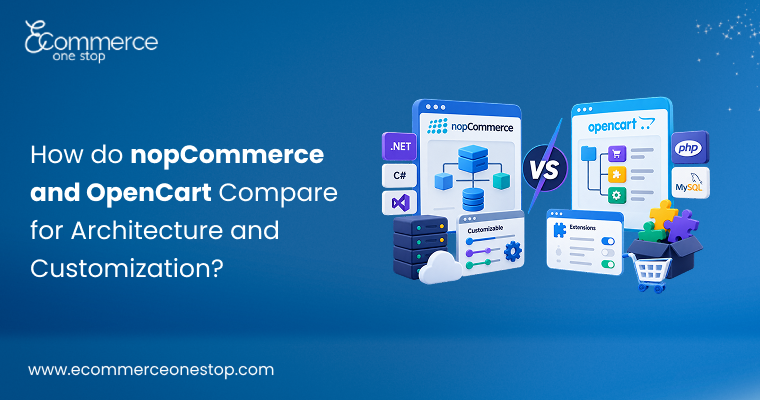
Picking between nopCommerce and OpenCart usually comes down to one question nobody asks out loud: how much pain do you want later, when the store needs to grow past what it does today? Both are free, open-source, and can run a working shop out of the box. What separates them is what happens six months in, once real customization starts.
Getting that customization right without breaking future upgrades is where most businesses get stuck. That's usually where partnering with a real nopCommerce development company saves time, since the .NET architecture and plugin system reward developers who know it well and punish shortcuts.
Here's what that looks like in practice. For Rama World, a long-running military gear brand, we rebuilt their OpenCart storefront with a dynamic product catalog and a cleaner inquiry system, while keeping 99.9% uptime through the switch. You can read the full Rama World OpenCart case study here.

How Do nopCommerce and OpenCart Compare for Architecture and Customization?
The split starts at the foundation. OpenCart runs on PHP and MySQL, the same stack behind a huge share of the web, which is part of why hosting it is cheap and developers for it are easy to find. nopCommerce runs on ASP.NET Core, which asks for more setup upfront but rewards you with a more structured, enterprise-leaning codebase.
Customization follows the same split. OpenCart's extension marketplace makes it fast to bolt on a feature someone else already built, but deeper, custom logic tends to mean touching core files, which gets messy over time. nopCommerce is built around plugins with their own controllers, views, and configuration, plus an event system that runs custom logic at specific points like order placement or payment updates. It takes longer to learn, but it stays cleaner as the store grows.
Neither is "better" in a vacuum. OpenCart wins on speed to launch and lower cost for a simple catalog. nopCommerce wins when the business already has rules, roles, and workflows that don't fit a generic template.
| Area | OpenCart | nopCommerce |
|---|---|---|
| Stack core | PHP, MySQL | ASP.NET Core, SQL Server |
| Customization Styles | Add-ons and modifications to core files | Plugins, Event Pipeline, Razor Overrides | Learning curve | Flatter, bigger PHP talent pool | Steep, requires .NET-savvy programmers |
| Multistore Management | Extensions not required | Native, single admin for multiple storefronts |
| Best Fit | Small-to-medium sized catalogs, rapid deployment | Organizations with complex policies or multi-brands requirements |
Can OpenCart Integrate With AI Tools?
Yes, though more through plugins than native functionality. There already exist AI-related extensions for OpenCart, ranging from product recommendations and chatbots to search functionality, while REST API allows connecting third-party AI services, such as those dealing with personalized pricing or generating content. The problem here is that AI integration in OpenCart remains quite an individual task, not just a simple switch on, and will strongly depend on the choice of extensions by your developers.
Which Platform Has Better Automated Features?
nopCommerce generally has the edge here because of its event system and Web API plugin, which lets it talk to CRMs, ERPs, and PIMs without a workaround. That opens the door to automating things like inventory sync, order routing, and customer segmentation directly through the platform's own architecture.
OpenCart can automate plenty too, but it leans more on third-party extensions to get there. For a store running a handful of automated workflows, that's fine. For a business trying to automate order-to-fulfillment across several systems, nopCommerce's native API support usually means fewer moving parts to maintain.
"Any fool can write code that a computer can understand. Good programmers write code that humans can understand." - Martin Fowler, Software Architect
Is NopCommerce Up to the Task for Handling Complicated Needs of a Business?
It is here that NopCommerce beats the competition hands down as its plugin-based system ensures that all functionalities remain independent of one another. It also supports running multiple storefronts from one installation, which matters for businesses managing several brands or regional sites under one team.
That flexibility isn't free. Complex requirements on nopCommerce still need developers who understand the .NET ecosystem, and that talent pool is smaller than PHP's. It's a trade worth making for businesses with genuinely complicated operations, and probably overkill for a straightforward single-brand store.
Is OpenCart Suitable for Enterprise Businesses?
For most enterprise-scale needs, not really, at least not without significant custom work. OpenCart was built for small to mid-sized catalogs, and while it can be pushed further, performance tends to need extra tuning, caching, and database work as traffic and product counts climb. On the market side, OpenCart actually has more total customers than nopCommerce, According to 6sense, which tracks OpenCart at a 0.31% share of the ecommerce platform market against nopCommerce's 0.10%, with most of that base sitting in small and mid-size retail rather than large enterprise deployments.
If the business genuinely needs enterprise-grade scale, most teams either lean on nopCommerce, invest heavily in OpenCart's performance layer, or look at a platform built for that scale from the start.
Which Platform Is Easier to Upgrade After Customization?
Neither platform makes heavy customization completely painless to upgrade, but they fail differently. OpenCart's habit of encouraging core file edits means an update can quietly overwrite custom work if it wasn't isolated properly. In general, nopCommerce’s plugin architecture allows for survival of changes after updates more effectively due to the fact that features exist in a separate layer and not in the core files.
"First, solve the problem. Then, write the code." - John Johnson, Software Engineer
What Should Businesses Check Before Choosing Between Them?
A few things worth confirming before committing to either platform:
- Map out how complex your pricing, roles, and workflow rules actually are before assuming you need nopCommerce's extra structure
- Check whether your team, or your development partner, actually has .NET experience if you're leaning toward nopCommerce
- Test extension quality on OpenCart before relying on it for anything customer-facing or AI-related
- Ask any OpenCart store development service for USA how they isolate custom code from core files, since that decides how painless your next upgrade will be
- Confirm hosting requirements early, since nopCommerce's ASP.NET stack costs more to host than OpenCart's PHP setup
What Sources Back Up the Numbers in This Blog?
| Statistic | Link |
|---|---|
| OpenCart holds a 0.35% share of the ecommerce platform market with 15,476 customers, versus nopCommerce's 0.11% share and 4,973 customers | 6sense.com |
| The global e-commerce software market was valued at $9.4 billion in 2025 and is projected to reach $34.2 billion by 2033 | grandviewresearch.com |
| nopCommerce plugins have their own Controllers and Views folders and a configuration page | http://docs.nopcommerce.com |
Conclusion
There's no universal winner between nopCommerce and OpenCart. OpenCart gets a store live faster and cheaper for straightforward catalogs. nopCommerce costs more upfront in hosting and developer skill, but holds up better once the business rules get complicated. The real decision isn't which platform is "best," it's which one matches how your business actually operates today, and where it's headed next.
As an e-commerce website development company in the USA, we work on several platforms. Hence, there is no point in us recommending one particular platform in order to get the project done. If you are confused about choosing one, our team will help you understand based on your requirements.

FAQs
1. How does nopCommerce compare to OpenCart regarding architecture and customizability?
OpenCart is PHP and MySQL. Customizing it means working through extensions, mostly. nopCommerce needs more setup because it runs on ASP.NET Core. But the payoff is the plugin and event system, which keeps things from turning into spaghetti once you start piling on custom features.
2. Can OpenCart be used with AI systems?
Sort of. You can hook it up through extensions and the REST API. It's not a toggle you flip though, more like a small dev project you'd budget time for.
3. Which platform offers better automation capabilities?
That's nopCommerce. Its Web API plugin talks to CRMs, ERPs, and PIMs directly. No duct-taping extra tools together to make it happen.
4. Is nopCommerce able to meet complex business needs?
Mostly, yes. Plugins don't step on each other, and it can run multiple storefronts off one install. Covers most complicated or multi-brand setups without a fight.
5. Is OpenCart good for use in enterprises?
Not out of the box. It's built for smaller catalogs, so scaling it up for enterprise traffic means putting real time into performance tuning first.